And so……things shifted for us in terms of the weather and therefore our feelings about Peru somewhere near Arequipa. While in the north we had plenty of grey weather, in the south the sun came out for real.


Views from the Pan-Am north and south - we prefer blue over grey
Arequipa is a big city and a tourist nexus, not usually our kind of place. But, it is well laid out, clean, and the weather was perfect while we were there. Our set up at the Hotel Las Mercedes worked well and allowed us to explore and enjoy the city with ease. We strolled the streets and lolled in the Plaza de Armas (as the main plaza is called in many South American cities, as opposed to Parque Central as it was called in Central America), we dined out and generally enjoyed our time there.
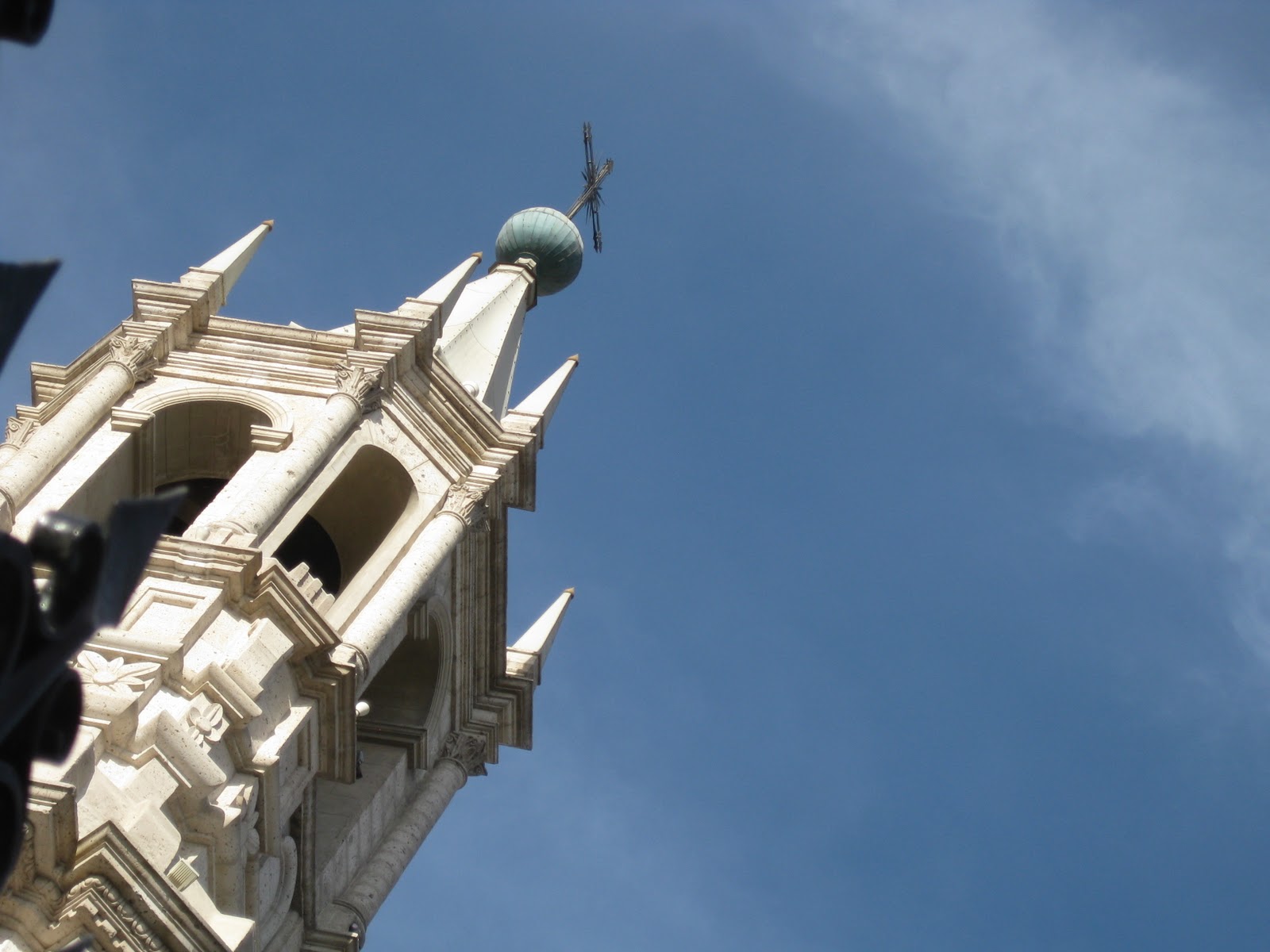
Cathedral on the Plaza de Armas - Arequipa
My requisite tourist activity was a visit to the Monesterio Santa Catalina where I spent a relaxing afternoon marvelling at how beautiful it is. Built in the 1500s and still in use today, it is so big they refer to it as a city within a city. Sure, the history and information on the lives of those who live there was interesting, but the setting was stunning.
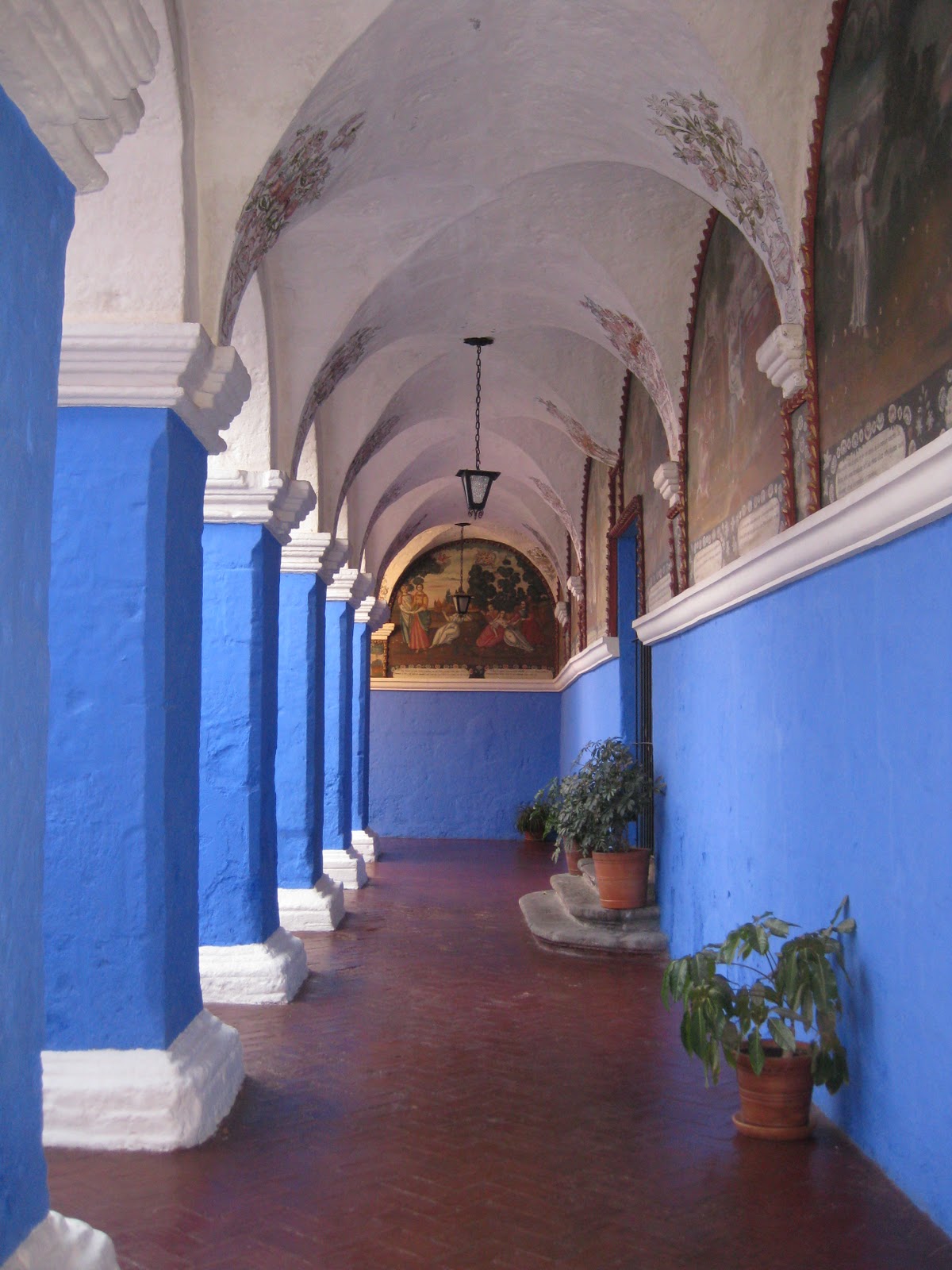


Scenes from Santa Catalina
At the Hotel Las Mercedes we bonded with Suzanne and Didi, a Swiss couple who are traveling north, comparing notes on highlight locations and best places to stay. It was a nice transition for us from northern Peru where we mostly ‘wild’ camped and interacted with few other overlanders.
The Peru-love meter began to climb.
Juxtaposed to Arequipa was the Colca Canyon, our next destination. About 3 hours from Arequipa and worlds away, Colca is deeper than the Grand Canyon. To get there we crossed a pass that was 16,000 feet—we were winded just driving.

Atop the pass there are hundreds, perhaps thousands, of little piles of rocks...very cool, kind of weird.
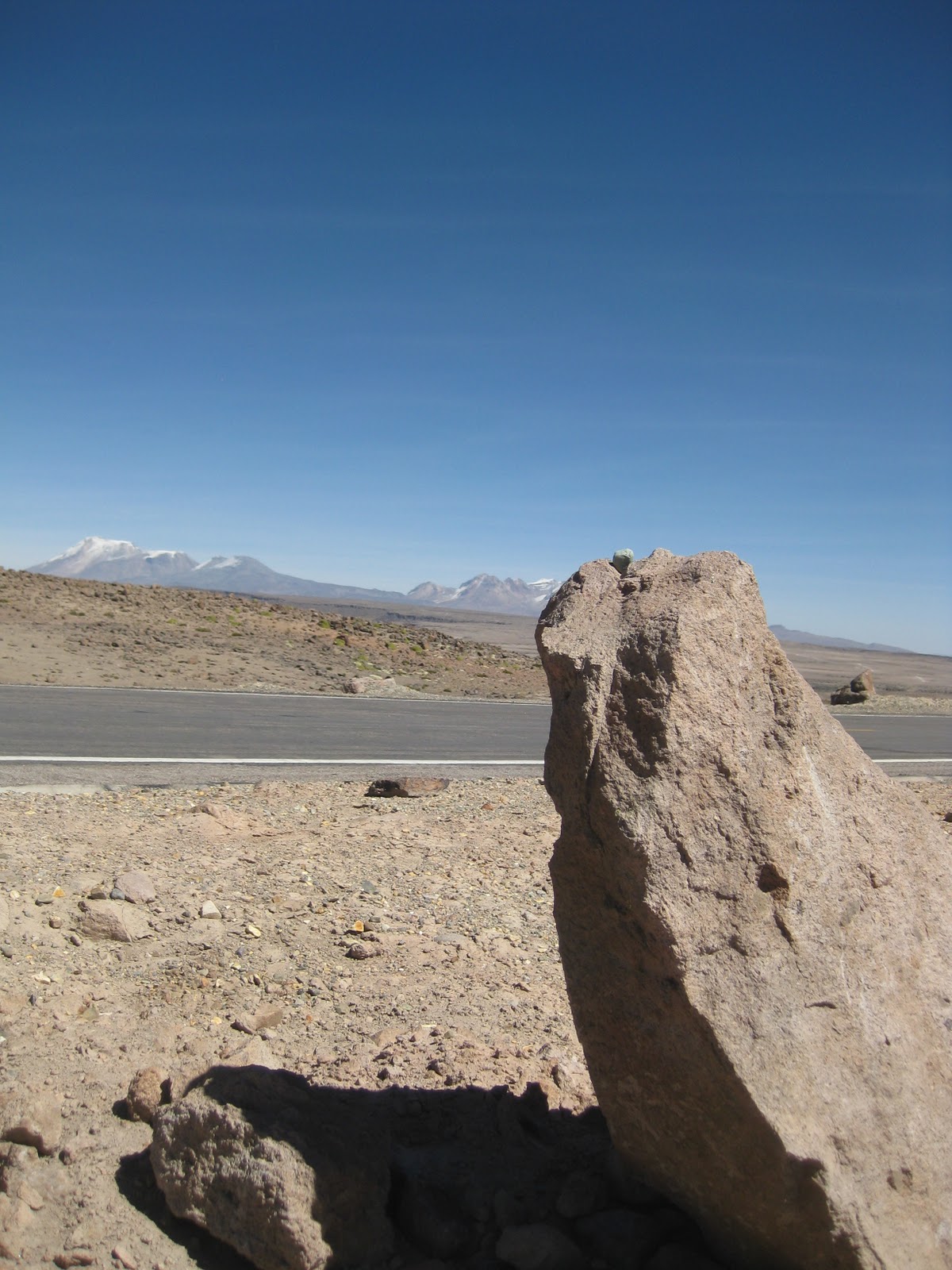
I left a ´lucky rock´we´d been carrying since Utah on another rock on the top of the pass
The Colca Canyon was great for us—plenty of wide open spaces with camping possibilities at every turn. We soaked in hot springs, Chet and I hiked to a ‘geyser’ (really a natural steam vent in the earth’s surface—super powerful and somewhat scary), saw Andean Condors and took in a program at the planetarium to learn more about the constellations we are now seeing.


Pre Inca terracing in the Colca Canyon


Andean Condors


Campsite near the geyser

Geyser - aka steam vent - Colca Canyon
Again, the weather was perfect: warm sunny days, cool, crisp nights (okay, the nights were really cold but we are equipped for that so it was no problem). There are a string of towns along the canyon rim and each had its own charming personality. In so many ways, the Colca Canyon was everything I had hoped Huaraz and the valley between the Cordilleras Negra and Blanca would be. The Peru-love meter climbed several notches.From here we headed towards Cuzco. This drive could have been done in one day had we taken the road most traveled. But since the cute girl at the tourist office told Mike that a different road would take the same amount of time, we set off on the road less traveled. By the time we realized that the drive time was going to be far greater we were well underway and it was pointless to turn back. So off-the-beaten-track was this route the road was not on my map but as we all know, sometimes these ‘mistakes’ turn out for the best....we forged on.
We came to a crossroads with precious little signage. Wanting to confirm that we were indeed headed to Cuzco, we stopped to ask two women who were sitting at the side of the road near the intersection. They were working on some craft-type textiles destined for some tourist´s luggage and listening to a static-y transistor radio. In addition to directions we inquired about the availability of gas, having set off without knowing we were headed to the hinterlands. One of the women (the more animated of the two, though they were both darling) said she had gas in town, 3 kilometers away. We loaded them up into the van and headed to town.

Our two new friends piled into the Burly Beast
And when we got there she and Mike funneled gas into our tank and our spare can for the journey. She owned a tienda (variety store) and I also picked up a few veggies and TP and off we went.

Along the road less travelled
The first night we stayed along the road at the start of a long stretch of altoplano. Very beautiful. Only us. Doubt many gringos have been here, let alone stayed here. And in the morning we continued on, across miles and miles of altoplano and herd after herd of llamas, vacunas, sheep, etc. Desolate but beautiful. Dirt roads the whole way.
I eyed the map and dead-reckoned to identify a few places we might be able to stay the second night, knowing we probably wouldn’t make it as far as the main road to Cuzco. The best choice was along the Laguna Layo. More driving, no laguna. Finally, a roadside sign for the town of Layo. We turned right and headed into town.
We asked a few people about places to camp and had identified our best spot and then stopped at a small tienda for some bread and water. Eduardo, a boy of 14 tending the store, was interested in the gringa (me), and asked where we were staying. I told him and asked if he knew of another place.
He told me other people camp at the end of the lake and so that’s where we headed. Yup, another cool campsite. The lake was beautiful and we hung here for two days watching the sheep, cattle and llamas go out to pasture in the morning and returning in the evening. Super peaceful. Again, our Peru-love meter rose.


The daily comings and goings of the local livestock

Chet at sunset - Laguna Layo
We worked our way to the famous-among-overlanders camping Quinta Lala and who should we find there but Suzanne and Didi our friends from Arequipa. They had arrived just two hours before. A ray of sunshine and the love meter climbed again. (Don’t ask me why I don’t have any pictures of them….we spent lots of time together but never got the camera out.)
Quinta Lala is a little oasis for travelers like us. It is just outside the city but an easy walk or short cab ride and it has what we need: bathrooms, hot showers, wifi, laundry facilities and a small kitchen. We stayed several days as other travelers arrived and left. Every few days llamas were brought in to help maintain the grass.


The scene at Quinta Lala

Exploring the side streets of Cuzco

Doorway Dogs - Cuzco
And then we had a decision to make: to Machu Pichu or not to Machu Pichu.
Reasons for going:
One-in-the-world kind of place
Certain to be powerful and impactful
People will think you are crazy if you were in Cuzco but didn’t go to Machu PichuReasons for not going:
A bit of a harangue to get there
Height of tourist season—reports of having to jostle with hundreds of tour-group members
We are traveling with a dog (though a friend offered to care for her while we went)
We are not ruin site fanatics
Mike was sick
Who cares what other people think
Many, many conversations later we opted out of the Machu Pichu experience and headed instead to the Sacred Valley. This was the right decision for us and the Peru-love meter climbed again.

One of our campsites above the Sacred Valley
The valley is beautiful and we spent plenty of time poking around its many side valleys and towns. One night on our way up the valley out of Ollyantatambo looking for a campsite we picked up two young boys walking home from school who flagged us down (everyone flags us down, we look a lot like the local ‘micros’ or ‘combis’ that the locals use as their main source of transportation. Also, people walking long distances will flag down any vehicle going by and as a vehicle going by it’s a courtesy to pick them up. It often opens doors and conversations for us.)
The boys hopped in and told us they lived 20 minutes further up the road. As we climbed higher in altitude, we asked if they knew a place we could camp for the night explaining we sleep in the van, showing them the bed, fridge, kitchen, etc. One boy said, Yes, he knew of a place by his house. Both Mike and I feared a yard full of chickens but we continued on, chatting with the boys and telling them about our lives and adventures and asking about theirs.
Finally the boy pointed out his house, down in a valley (no access road to the house; not needed if you don’t have a car) and then pointed out a small, level plot at the side of the road where a new house was being built. The workers were just finishing up for the night and said it was okay for us to stay there. Cool. We got what we needed (a place to stay) and the buys got what they needed (a ride home). BTW, they walk about 2 hours (one way) to school every day.

One of the boy´s houses below our campsite
They stayed and talked to us for a long, long time just wanting to know about our lives. And we were joined by several other kids as they made their way home from school (Again, didn’t get the camera out. I feel awkward about putting a camera in someone’s face just for being who they are.) The next morning as we worked our way down the valley we encountered some of the same kids (though not our two original boys) and each of them flagged us down. We ended up with 8 kids in the van and served as the local school bus that day.
Of course, we communicated in Spanish but I asked one of the boys what language he used when he spoke with his friends and he told me Quechua, the language of the indigenas. Such a treat for us to see this glimpse of a world so different from ours.
As we dropped them off at the school the teacher was waiting at the door (checking us out to make sure we meant no harm) and laughed when I told the kids to ‘Aprender mucho’, (Learn a lot!). Here, we did bust out the camera as by now they seemed more our friends than an oddity to be photographed.

Trish and the school kids
We tracked our way up and down the Sacred Valley enjoying the setting and the scenery. In order to appease the Ruins Gods for our decision to opt out of Machu Pichu, we toured the ruins at Ollantatambo thinking if we were so moved by the experience we could still make the trip to Machu Pichu.
We had a great guide who understood we were as interested in hearing the information in Spanish as we were in what was being said. He obliged us by telling us about the site first in Spanish and then in English, so we could check if we were ‘getting it’. He also doubled as our photographer, asking for the camera at all the key photo-op locations. (Reminded us of our wedding in Salzburg where, for $26, a man played Mozart melodies and doubled as our photographer…a story for another day).


And after our visit to the ruins at Ollantatambo we stopped into Inca Bucks for a coffee
The ruins were….interesting. While I wanted to be so moved I’d just have to go to Machu Pichu, I found them interesting and pretty, and that was that. Answer me this: if you go to (or live in) Colorado but have never been to Mesa Verde, have you seen Colorado? We continued to poke around the Sacred Valley, with one more great encounter that must be discussed. We ended up one evening at Los Girasoles, a lodging accomodation owned by Peruvian, Jose Luis and his Austrian wife Christa. It is a little slice of paradise, very serene and peaceful. When Mike called in at the gate he saw a beautiful Westfalia parked on the property and figured it was another traveller.
The Westy was actually owned by Javier and his wife Patricia who are living in one of the houses on the property while their house is being built. We instantly bonded over the Westys and Mike shared lots of information on the various systems as they haven´t owned it very long. They in turn shared the home-made lp gas tank adapter with us, that made filling our tank the next day a breeze. They could be the only ones in all of Peru that have such an adapter and it was incredible that our paths should cross.
Patricia and Javier invited us to their house the next night along with Jose Luis and Christa. We shared a great evening and felt more like old friends than lodging guests. It is a rare gift indeed to be able to make people feel so welcomed and comfortable in such a short time. This sent the Peru-love meter higher still.
We eventually left the Sacred Valley and headed towards Lago Titicaca.
On our way to Titicaca we stumbled into the gorgeous Canyon Tinajani (not in any guide book or even labeled on the map) and spent two incredible days lounging in the sun, hiking and gaping at the scenery.

This forlorn sign....


...led to this scenic, Utahesque canyon
Then on to Lago Titicaca where we stayed in several different places, each with its own personality.
Puno: Big city with corrupt police who tried twice within our first hour in town to extort money from us for some fictitious infraction of the law. Our lodging was in a hotel parking lot, not our favorite, but convenient with a shower that rocked and stong wifi. Puno highlight: touring the Yavari, a ship that was made in England in the 1800s and shipped in pieces and carried over the Andies to Puno. Cool ship, moored right behind the hotel.

Yavari
Llanchon: My personal favorite. Small indigenous village at the end of Capachica Peninsula. Beautiful setting that gave us a glimpse of what the lake and its villages were like before the masses arrived. We met some kindly locals. We hired a local fisherman to take us to the island of Taquile that was beautiful but sadly, lost to tourism. We wild camped on the shores of the lake and watched local life go by for several peaceful days. At night we had great views of the lights of Puno across the lake.

Grazing sheep - Llanchon

Storm clouds gathering - looking towards the Bolivian side of Titicaca



 Posts
Posts

