Sunday, August 8, 2010

A few pictures from our travels in Ecuador

Mike in Tulcan Ecuador
Tulcan Cemetary - known for its elaborate topiaries...think Edward Scissorhands
Laguna Yaruacocha, Ibarra Ecuador
Camped along side the lake that is just outside of the city. We asked at the toll booth on the way in if it was safe to camp overnight and were told yes, no problem. We were awakened at 2am by the police who were checking on us. Makes your heart pound when someone is knocking on the door in the middle of the night. Made Chettie bark like crazy, our alarm system. After explaining in sleepy spanish that we were told it was okay they left us alone.
Trish walking on the equator. We skipped the very touristy Mitad del Mundo and stopped instead at this smaller roadside acknowledgment of the crossing of the equator.
We didn't know it then, but because of our delay waiting for car parts we would cross the equator several times.
Latitude 0 0'0'' - cool

VW Love outside of Jamanco Hot Springs, Papallacta
Mike on the shores of Laguna Papallacta. This was our first time at the laguna and yes, it was very wet. Again, we didn't know it at the time but we would return here several times.
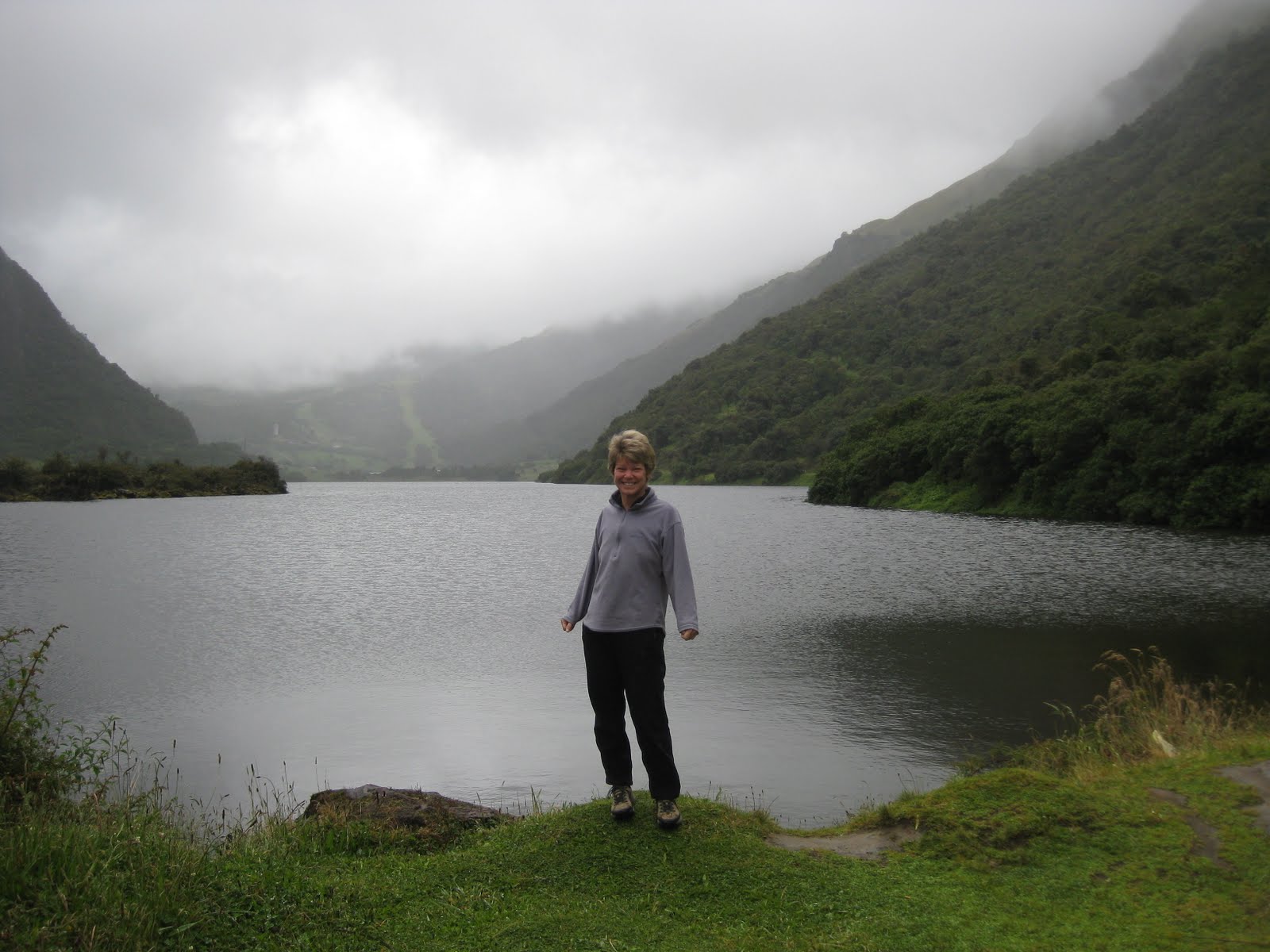
Trish at Laguna Papallacta. High in the paramo, this area is often shrouded in clouds. For many, this is the only view of the area they see. Our many return trips allowed us to see the area in many different conditions.
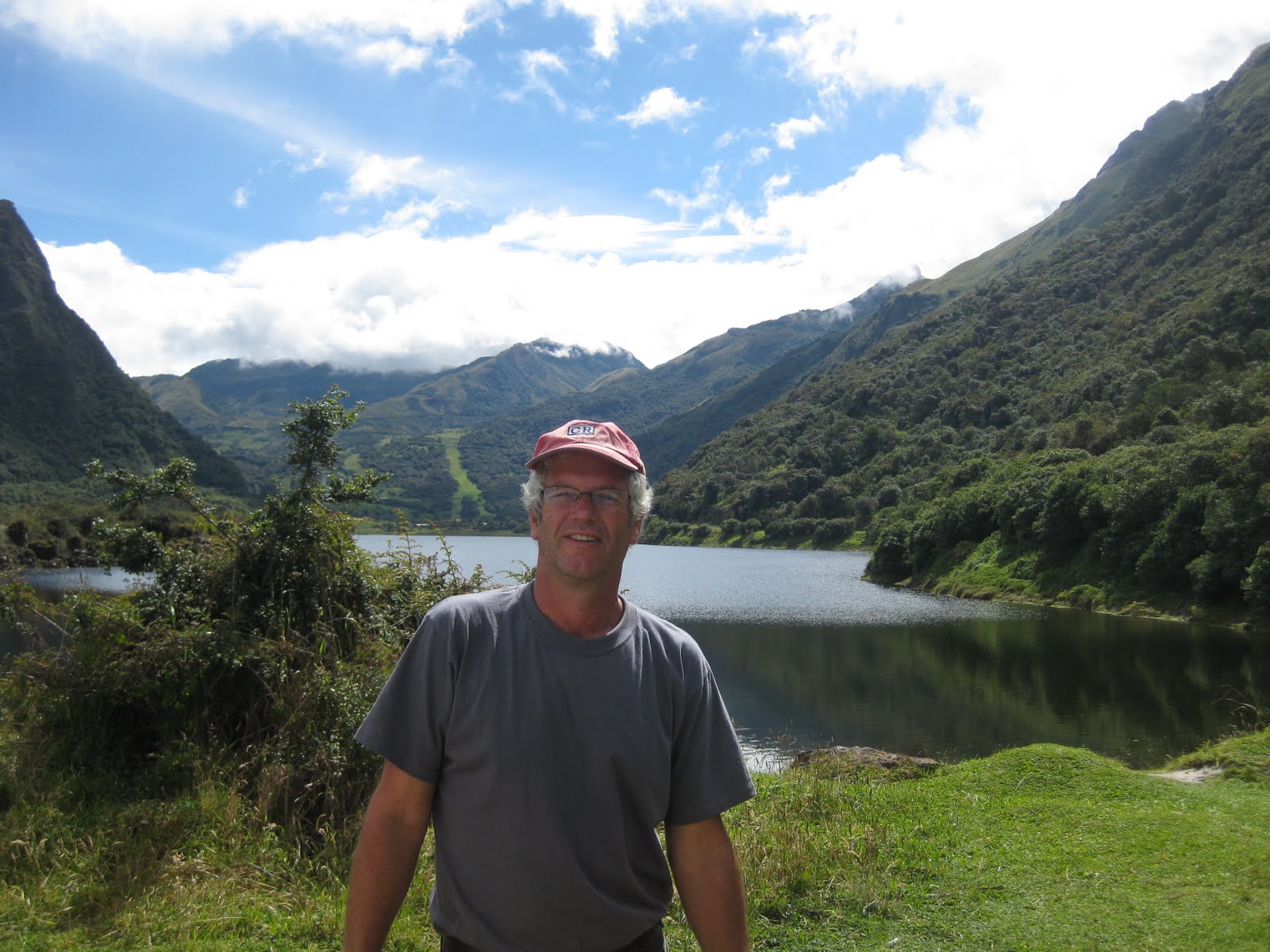
Mike in the sunshine at Laguna Papallacta
The Burly Beast on the shores of Laguna Papallacta
A funny sign on the way to Jamanco Hot Springs. "Siga" means follow and it's what is said when you enter a business or when getting directions. This sign was written backwards on the rock and was on the right side of the road.
Volcan Cotacachi from trail around Laguna Cuicocha
Volcan Imbabura from the trail around Laguna Cuicocha. These two volcanos flank the town of Otavalo and again are often cloaked in clouds. We saw many faces of these volcanos as we explored the area in and around Otavalo.
Laguna Cuicocha with the Burly Beast. We camped here one night and were the only ones here. A few days later, on a Saturday, we returned for another night to find thousands of indigenous people celebrating the festival of Inti Raymi. We stayed and observed the festival for a long while but did not camp here that night. We did not take pictures of the festival as it seemed very inappropriate.
Trish at Lagunas de Mojanda, about 10km outside of Otavalo. Again, we camped here and were the only ones on the lake.
Mike with Fuya Fuya near Lagunas de Mojanda
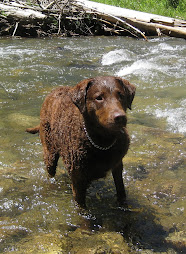
The Chetster at Lagunas de Mojanda. I'm happy to report that she is doing great. We took the opportunity to visit a vet while in Pifo and she got a clean bill of health. She is a great traveller and provides great companionship for us. Never one to complain, she is tickled when we find a place she can run free. Swimming is also high on her list of favorite activities. Laguna de Mojanda was very cold, but it didn't stop her from an afternoon of log retrieving.
Mike at the waterfall on the property we camped at in Mindo.
Mindo waterfall
Rafting on crafts made of inner tubes lashed together is very popular in Mindo
Loading up the innertubes. Of course, this sight reminded us of Salida.
There is a lot going on here. I took the picture because of the Burly Beast's reflection on the television set. Just at the moment I snapped the picture, Brazil scored a goal during a World Cup match. You can see the Brazilian players in yellow jerseys on the TV celebrating the goal and can see the joy on the face of the guy watching the match.

We travelled south along the Avenue of the Volcanos after leaving Lucho one last time. It was beautiful but very cold and wet because of the season and the altitude. Laguna Quilotoa (above) is known for its turquoise color....we only saw it in gray and it was incredibly cold and rainy while we were there. And after this we headed to Banos at a lower altitude to dry out and warm up.

Our camp site in Banos in the company of a big Mann vehicle owned by a very nice French couple, Sebastian and Sebrina (Seb & Sab). They were having some vehicle troubles and we took comfort in knowing others have dealt with mechanical issues. When we left, Seb had taken a bus into Ambato (the closest big city) to try and get the parts he needed. We only hope he wasn't told, 'Aqui no hay'.
Mike and Seb working on their respective vehicles. Sabrina and I took the time to share information on places we have stayed, as they are headed north and we are going south. Our location also allowed us to explore the town on foot and to hike directly into the surrounding hills. BTW, the hot springs at Banos are not nearly as nice as those in Papallacta even though this is what the town is known for.
Mike sharing a moment (and a carrot) with the horses on the property we camped at in Banos.

Late one rainy afternoon we asked at the Bomberos (fire station) where we could camp in their town. "Right here", they said and we camped at the station. Great guys, they loved the Burly Beast and and even shared their bathrooms and hot showers with us.
Hot and dry atop Tinajilla Pass. As we headed into southern Ecuador the landscape turned to desert and the weather began to warm up. We had spent a lot of time high in the Andes and the first few days of clear skies found us basking like lizards in the sunshine
Mike enjoying the warm dry weather in southern Ecuador


Though we see plenty of livestock, this was unusual as this pig passed through our camp site unaccompanied one afternoon, apparantly on his way home for dinner

...And with that we left Ecuador and headed into Peru

Thursday, August 5, 2010

Lucho and Hacienda Sigsipamba

It happened like this:


We ordered car parts in Ibarra and set out to explore northern Ecuador while they were shipped via FedEx, when we ran out of LP gas for the stove in the van.

We asked around in Ibarra but were told, ‘Aqui no hay’, literally, here there is no. We were directed to Quito for the nearest place to refill our tank. Early the next morning, off to Quito we went (a two hour drive).

After hunting around for the address in Quito we discovered this location was not the plant but rather a tank distribution center, and again we were told, ‘Aqui no hay’. We were directed to Guayaquil, a big port city at the southern end of the country. We were not going to Guayaquil, not for gas nor anything else.

Mikegyver had an idea: perhaps if he had the right adaptor he could rig the stove up to a gas canister we have for the Coleman lantern. This didn’t sound like a great idea to me, but he is Mikegyver after all and he certainly has had plenty of experience with gas piping. So of we set off looking for an adapter. A couple of ferreterias (hardware stores) later we were still empty handed, ‘Aqui no hay’.

Hmmmm…perhaps if we went back to the tank distribution center they’d have an adapter they could sell us. Found the place the second time easy enough, but, alas, ‘Aqui no hay’.

Fate intervened at this moment and a different guy told us there was an actual gas plant in Pifo, about an hour away.

So, with a hand-drawn map, off to Pifo we drove. Mike thought it might be yet another wild goose chase but I knew Pifo was on the road to Papallacta, an area known for hot springs, so I knew our efforts would not go unrewarded.

Unbelievably, we found the gas plant, just outside of Pifo. More unbelievably they told us they could fill the tank, but that we’d have to wait a half hour. No problem. We waited. More like an hour and a half. And then a guy came out and told us, ‘Aqui no hay’.


Our hearts sank until fate stepped in again and another man, perhaps el jefe, came out and said yes, it was possible. He told us to wait for a truck that had just been filled to come out of the plant and ask them to fill our tank. Super. We waited some more.

Indeed a truck came out and indeed he was able to fill our tank. Mission accomplished!

However, by now it was 5pm and starting to get dark and we were in an area well off the tourist trail. We headed back into Pifo proper, scouting for places to stay but didn’t come up with much.

We asked at a crummy hostal and were told we could stay there, but we’d have to rent a room and Chettie would have to stay in the van. We kept looking.


We asked at a vivero (plant nursery) but the guy there was not the owner and he wasn’t comfortable allowing us to park there overnight. He directed us to another road and said there was a place we could camp, but we didn’t quite understand the whole conversation (our Spanish/his manner of speech). Eventually we drove up the road to see what we might find.


We spied an old hacienda with lots of land and plenty of level ground for us to park on. Not the place the nursery man had sent us to and not in any way a lodging establishment, but a cool looking place. Given the hour I headed down the long drive to ask if we could park there for the night.
The long drive into to Hacienda Sigsipamba

As I walked towards the main building I began to hear Banana Pancakes by Jack Johnson. Hmmm, this had promise. I explained to the guy at the end of the drive that we needed a place to park for the night. Didn’t need anything else. He said, ‘Ask Lucho.’

With that, the incredibly gregarious Lucho sticks his head out from the engine of a very, very large Mann vehicle and says ‘Si, claro!’ with a big grin. Yes, sure.


We parked the van and exhaled. We were tucked in for the night in what felt like a great place. We could not have guessed what role this place would play in our time in Ecuador.

Because of a classic ‘snafu’ in the shipping process it took nearly three weeks for us to retrieve the auto parts, though they were in Quito within a few days of ordering. We spent our time exploring the greater Quito area (including several trips to the hot springs at Papallacta) and northern Ecuador, returning to Lucho’s several times using it as a headquarters of sorts. Mike eventually did the auto mechanics there.

Hacienda Sigsipamba is a sprawling old hacienda. Though it needs a ton of work it exudes cool. Fabulous views of the valleys below and of Volcan Cotopaxi. One does not have to work hard to imagine the place in its former glory. Lucho was just as smitten with our van as we are, ‘Que hermoso carro’ and though we tried to trade the van for the hacienda, Lucho didn’t go for it.

Bird's eye view of Hacienda Sigsipamba

Volcan Cotopaxi from Hacienda Sigsipamba

Each time we returned we were greeted like favorite cousins not seen in a long time. We were the only gringos at Todo Terreno, a 4-wheel drive, motorcycle and bicycle competition held on the property while we were there. We met Lucho’s sister and little brother. We met his friends and his girlfriend. We met his dogs. Hey, we even met Superman.

Lucho serving up burgers at Todo Terrano
Lucho's dogs
Mike and Zeus

You know who this is...

Lucho defines joie de vivre. Had we not run out of LP gas, had we not returned to the gas plant to ask for an adaptor, had the nursery man said yes, and had a million other twists of fate not intervened we would not have landed at Hacienda Sigsipamba nor met our friend, Lucho.

Trish and Lucho

And as we said our last good-bye’s Mike said ‘He could have been a rock-star’.

Monday, August 2, 2010

Alive and Well

You´ve probably been thinking that Trish and I have broken down and are stuck on the side of the road somewhere. No, we are still heading South and are currently in Southern Peru on our way to Arequeipa after spending some time touring the desert coast. We will post a more detailed blog with pictures etc. when we get to Arequeipa.

Mike

Friday, July 2, 2010

Colombia, El riesgo es que te queras quedar


We were given a poster with several must-see Colombian sights with the above tag line which roughly translates ‘Colombia, the risk is that you want to stay’. This one simple line sums up Colombia perfectly.

Sure, we’d heard the warnings about Colombia. But these fears were expressed exclusively by people who had never been. Those who had been raved about how wonderful Colombia is. We knew we had to go.

Ten years ago Colombia was a very different place than it is today and the serious warnings were in place from that Colombia not this one.


Ten years ago, the guerrillas and paramilitary groups had a tight hold on the country and even Colombians were reluctant to travel. Then, in 2002, the very popular Alvaro Uribe was elected and he began to turn things around. He took a hard line on the militant groups and began to reduce their size and power.


He began a campaign called Vive Colombia which encouraged Colombians to travel to the great places within their country, ensuring their safety by setting up police check points along the highways. It worked and people began traveling again. We all know the power of tourism dollars and the economy began to grow.

Uribe was so well liked that he was able to pass a referendum allowing him to run for a second term in office, something previously prohibited within the Colombian system. He ran again in 2006 and won by an impressive margin. It was about this time that foreign travelers began to trickle in and the word of Colombia’s wonders spread.

Uribe again tried to pass a resolution allowing him to run for a third term in 2010, but the request failed. (Term-limits are a good thing, even when the current administration is popular, right?)

From a field of 10 candidates, two emerged as the front runners. Mockus, a green-party candidate and former Bogota mayor, is known for his unorthodox style and his Hickenlooper-esque everyman-appeal. His detractors said he wouldn’t be tough enough on the guerrillas and paramilitary groups and would lose ground that had been hard won under the Uribe administration.

The other front runner was Santos, the former defense minister under Uribe. More the conservative, his detractors said he was too hard line and would do nothing to improve tense relations with two important neighbors, Venezuela and Ecuador.

So popular was Uribe, and so grateful were the Colombian people, as the elections approached we saw bumper stickers that said ‘Gracias, Uribe’. Powerful.

May 30 was a rainy election day. RadioUno, the national radio station, took calls from people all over the country and chatted with them about the atmosphere in their area. The anticipation was palpable.

We were advised to keep things on the down low and not to travel that day. In the past there was violence on the roads as people from remote villages traveled to towns to vote. We didn’t see any problems but I did read there were a few problems of this nature on election day.


When the votes were counted Santos had received 46 percent of the vote and Mockus only 23 percent. Neither candidate had received the required 50 percent. A run off election was held on June 20 in which Santos received 69 percent and Mockus only 27.5. The people had spoken and they chose security over style.

NOW is the time to visit Colombia. It is beautiful. The people are unbelievably friendly. Of the nine countries we’ve been in so far it is our favorite. The risk is that you’ll want to stay.

Tuesday, June 29, 2010

Leaving Villa de Leyva and Heading South

Busting out of the Zona de Camping

It took us three tries to get out of Villa de Leyva. Each time we’d leave we’d get a little way down the road and decide there was an adjustment we wanted to make on the van. Thinking it would be easier to do it in a familiar and back to the Zona we´d head.

Our last night there was a Saturday. We returned to the Zona and as always we had the place to ourselves. Then two cars pulled in with about 12 college aged kids who immediately set about partying. No problem, we’d enjoyed the company of other kids during our stay. Mike went to check the internet and while he was away two more cars pulled in. I started to have a bad feeling. When Mike returned he read my mind, saying, “Maybe we should go somewhere else for the night.’ We were gone in 7 minutes.


We’d been in Villa so long we knew of other places offering camping and we ended up at a place high above town. It was an interesting way to bid Villa de Leyva good-bye, having a bird’s eye view of our little burg. The next morning we went by the Zona to see no less than 15 cars and twenty-plus tents crowding the place we had called home for over a month. It was a big holiday weekend and boy, were we glad we had vacated.

Our final view of Villa de Leyva

NP Iguaque beyond Villa de Leyva

When we finally left Villa, we headed to an area we had come through earlier and found an isolated piece of land with great views and no one around. We loved Villa de Leyva, but we were definitely in a fish bowl and we were craving some privacy. We spent the whole day gaping at the incredible views and sighing relief that our engine project was behind us.


Our campsite between Arcobuco and Tunja


Chillin'

Then we worked our way south and west nipping Bogata, crossing the Central Cordillera and dropping into the coffee growing region. Though it was great to be on the road again, almost instantly we felt the van just wasn’t running right.

But wait...Did she always run like this? Did she ever have power?  We were in some steep mountains. And every day we (Mike) would make adjustments trying to dial things in. Eventually we knew the engine was dialed in and we began to suspect there were other problems.

Nothing to stop us from continuing our travels, but clearly making driving tedious. There was no 'fahrv' in the 'nugen'. Each day Mike would try something different as he tried to zero in on what the issue(s) were, careful not to adjust too much lest he create confounding variables.

 Dawn at Los Nevados National Park (approx. 12,000 feet)

Our travels took us to Salento where we crossed paths with some fellow travelers we had met in Mexico. We had fun comparing notes and getting to know Trond and Roz a bit better.

 
 Mike, Chettie, Trond and Roz

We toured the area west of Salento, up the Valle de Cocora known for its soaring wax palms. It is a pretty area but the rain that had been falling daily since we got to Villa de Leyva now started to fall heavily and it started to cloud our fun.


A study of wax palms in gray


Salento's wooden buildings, different from the adobe we'd been with for so long.

As Roz and Trond left seeking sun and their new roof-top box, Ernesto and Claudia arrived: Swiss travelers in a tricked out Land Rover Defender. Roz and Trond had also told us of another VW Westfalia they had seen in Salento with Swiss plates, so we passed the word on to Ernesto and Claudia and they set off (in the rain) to find their countrymen. When they returned they invited us to dinner with Steph and Janine. We had a great time with them, again sharing road stories, talking politics and life.


Janine setting the table. (Yes, Ernesto and Claudia are travelling with a full place setting for six!)

Claudia, Janine, Ernesto and Steph feasting on a great 'Stone Soup' dinner

Steph showing off his VW belt buckle (this guy was dyed in the wool VW....his jacket is VW and the dinner contribution they brought came in a Westfalia bowl.)

By now we were getting pretty tired of the rain and also the van issues. We knew of a German engine rebuilder in Pasto from some earlier travelers and we headed that way to seek out his advice. Carlos Koch was a nice guy and he referred us to another engine dude who gave the engine a once over—checking the timing and valve adjustment. While there, Mike also put in a new oil pump that Jim had brought but that hadn’t been installed.

Still, the Burly Bitch (her new nick-name) just wasn't running right.

While in the Pasto area we stayed at the very lovely Hotel Sandamanoy on Laguna de la Cocha. It is a nice old lodge in the Teddy Roosevelt tradition. We were the only ones there and although the rain continued to fall it was a very pleasant place to stay. We got to know the staff and owner. They were all great. The Laguna is beautiful and I snuck in a little boat ride during one brief break in the weather.


The Burly Bitch at the Hotel Sandamanoy

Hotel Sandamanoy
Laguna de la Cocha

Hotel Sandamanoy from Laguna de la Cocha

Laguna de la Cocha

Still, the ever-patient Mike continued evaluating our vehicle problems, which ran to a failing clutch master cylinder and an erratic voltage regulator on the alternator that produced several-seconds long 18.5 voltage power surges (twelve to fourteen volts is normal). These surges subsequently confused the fuel injection system.

The old girl just wasn’t having fun, and I don't mean me ;-)


We then crossed into Ecuador. The scenery continues to be outrageous. Soaring peaks, lush valleys, rios, lagunas, lagos, and oh, yeah, hot springs. But more on that later.

We came across a Volks Wagen dealer in Ibarra and decided to have some parts shipped to them directly, which we are waiting for. The service guys at the dealer cleaned the fuel injectors and declared one bad. No problem, new ones are on the way. Mike cleaned the brushes on the alternator and that seems to have settled the power surges down. New alternator is also on the way. The oxygen sensor, new in the last month, has also been cleaned and seems to be sending the proper voltage to the injectors.


We are clearly headed in the right direction, but only after some trying times made even more difficult by the ever-falling rain. And this is the dry season! Even the locals everywhere we’ve been have commented on the weather. Today was the first day of true sunshine since we left Villa de Leyva….but the day isn’t over yet.


Don't get me wrong. Despite the wet weather and the car issues we have had some great adventures and seen some beautiful places. I mean, we're in Ecuador! We are enjoying ourselves and our travels and we are looking forward to that which is to come: the rest of Ecuador, Peru, Bolivia, Chile and Argentina. Ushuia for Christmas!